Guide
Foundation repair methods, and what each one is for
Foundation companies tend to favour the system they own the equipment for. Knowing what each method is meant to do lets you ask why it suits your house. This page describes them; it does not rank them.
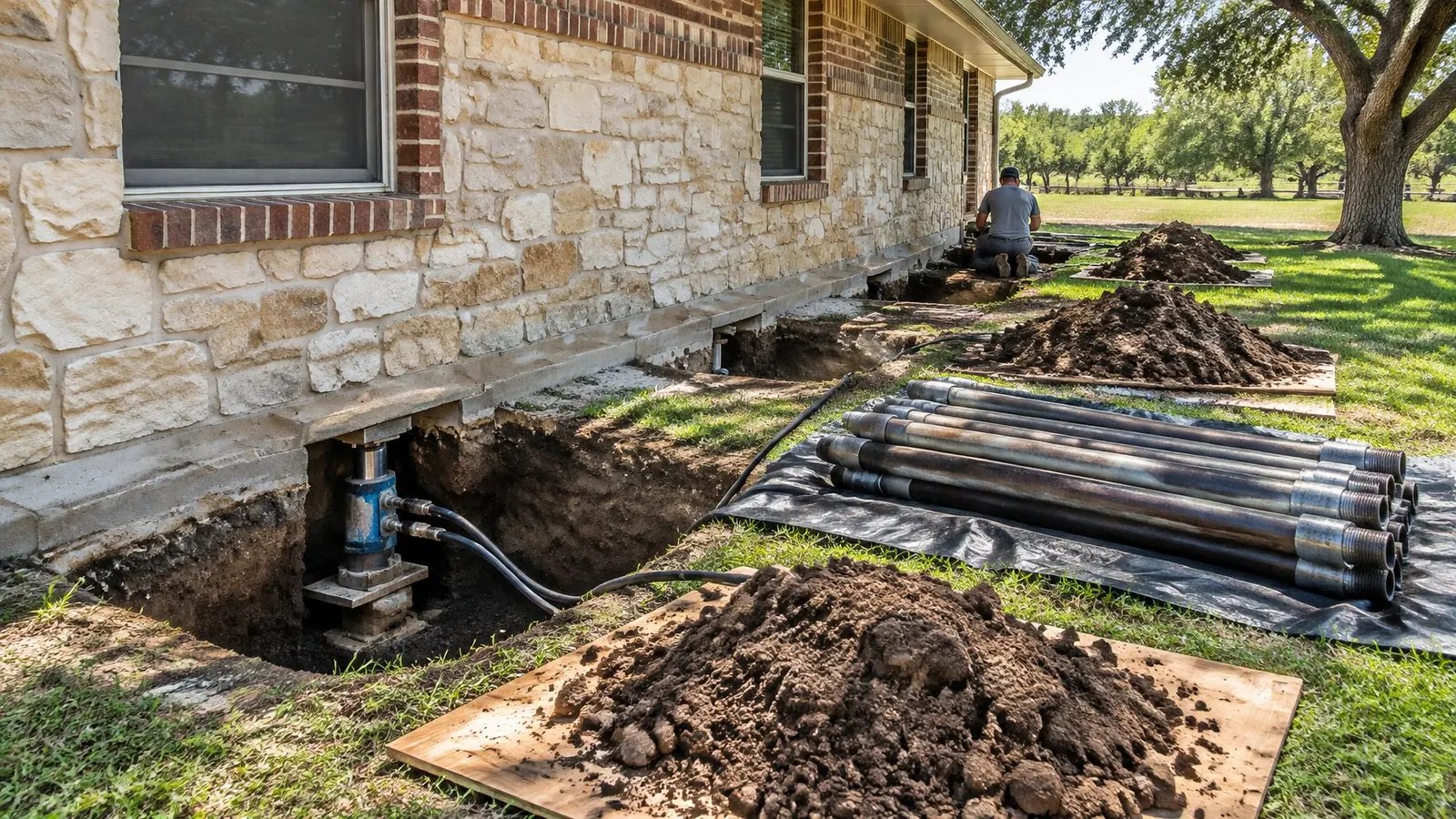
Piers: carrying the house to deeper ground
All piers do the same job by different means. They pass through soil that moves and rest the load on something that does not.
- Steel push piers
- Sections of steel tube are jacked down in sequence, with the house itself serving as the counterweight for the jack. The crew keeps adding sections until the gauge shows the tube will go no further under that load. Slim, able to go deep, workable in a tight space.
- Pressed concrete piles
- Precast concrete cylinders, stacked and jacked down by the same principle. Widely used on Texas slabs. Their final depth is governed by the stiffness of the soil and by the load sitting over each stack.
- Helical piers
- Think of a giant wood screw: a steel shaft carrying one or more spiral blades, wound into the soil by a torque motor. Installation torque is the installer's measure of what each one will carry. Since nothing has to push back against them, they are a common choice under porches, chimneys, additions and other light loads.
- Drilled concrete piers
- A shaft is drilled, sometimes widened at the base, fitted with reinforcing steel and filled with concrete. The concrete must cure before it takes load, and the drill rig needs space. In rock, drilling is slower but the bearing is firm.
For any pier, ask what tells the installer to stop: a depth, a pressure reading, a torque figure or contact with rock. The answer should be recorded for each pier and given to you.
Lifting a slab from below
- Grout injection
- A cement-based slurry pumped through holes in the slab fills the space beneath and raises the concrete as pressure builds. The old name is mudjacking.
- Polyurethane foam
- A two-part resin injected through small holes expands under the slab. It is light and sets within minutes.
Both are used for interior floors that have sunk, driveways, walks, porches and patios, and for filling voids left after piers have raised the perimeter. Neither reaches below the active soil, so on ground that keeps moving they are not a substitute for piers.
Pier and beam work
- Re-shimming
- Beams are eased up with jacks and shims are reset so every pier carries its share again.
- New or replacement piers
- Extra supports shorten sagging spans. Leaning or decayed piers are swapped for concrete ones on proper pads.
- Beams, joists and sills
- Rotten or cracked timber is cut out and replaced, or new lumber is fastened alongside to stiffen it.
More detail on the pier and beam page.
Work that supports the main repair
- Drainage correction
- Regrading, gutter extensions and yard drains keep the soil moisture around the house more even. Sometimes this is the whole repair.
- Root barriers
- A trench lined with a barrier between a large tree and the house limits how much moisture the roots draw from under the slab.
- Under-slab plumbing repair
- If a leak caused the movement, the pipe is repaired by tunnelling or through the floor before or along with the lift.
- Wall anchors and braces
- Tie-backs, upright steel beams or straps hold a wall that soil is pushing over. Slab houses have no use for them; a tired retaining wall on a hillside lot sometimes does.
- Tunnelling
- Reaching piers under the middle of a house by digging beneath the slab from outside, instead of breaking through finished floors.
Questions that apply to any method
- What caused the movement, and how does this method deal with that cause?
- How many supports, where, and how was the spacing decided?
- What depth or bearing do you expect on my lot, and how is extra depth charged?
- Has an engineer designed or reviewed the plan?
- What will you measure before and after, and will I get the readings?
- What is not included: plumbing tests, landscaping, flatwork, interior finishes?
How those answers feed into the price is covered in what affects the cost.
When you are ready
Pages can narrow it down. A level and a floor plan settle it.
Whichever side of the escarpment your house stands on, the answer comes from numbers taken on the spot. The firm that makes the visit then sets down on paper what it measured and what a repair would run to.
Sudden shifting, the smell of gas, or a wall that seems about to come down is a different matter: clear the house first, then dial 911 or your gas provider.
Have your New Braunfels house measured
Ring the number and describe the crack, door or floor that worries you. Whoever answers works for a foundation repair firm near New Braunfels, a separate and independent business, and can book a day to inspect.
Call (830) 879-9995Your call may be recorded. The referral disclosure explains who is paid.