Signs
Cracked brick, drywall and ceilings
Drywall and brick veneer have no give in them, so a small shift in the framing behind shows up there before anywhere else. Both also split for everyday reasons unrelated to what the house stands on.
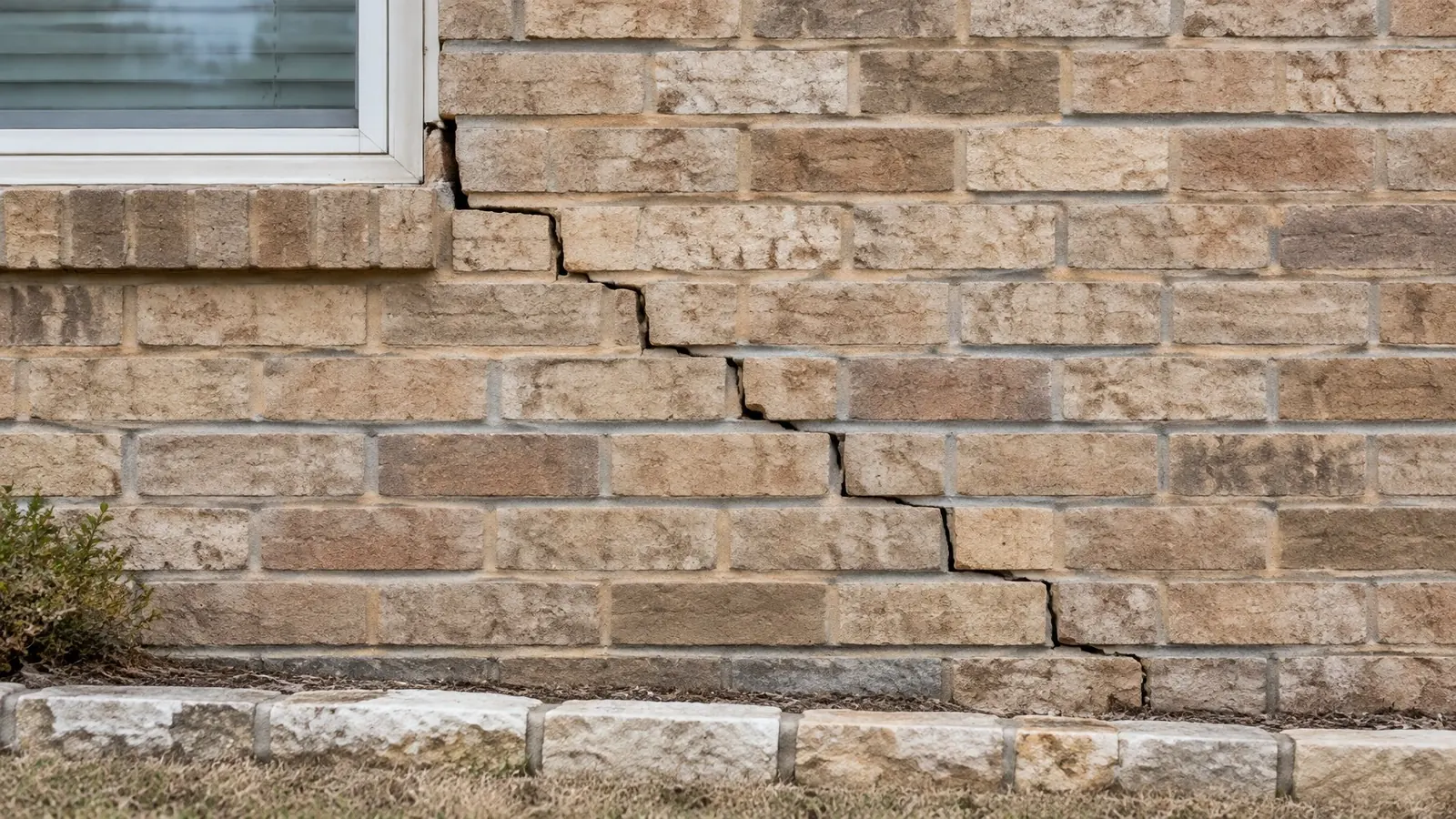
Patterns that point toward movement
Location and shape say more than size. These are the patterns a foundation company pays attention to:
- Stepped cracks in brickwork, climbing through the mortar like a staircase and commonly setting off from the corner of a window or door.
- Taper: a crack broader at its upper end than its lower, or the other way about, records the direction in which the wall has tipped.
- Slanting cracks in drywall that leave the top corner of a door or window opening and head for the ceiling.
- A gap where the wall meets the ceiling, or trim and crown moulding pulling apart at the joints.
- Brick separating from a window or garage door frame, with old caulk stretched or torn.
- Repairs that fail: a patched crack that reopens along the same path within a season or two.
Other things that crack walls
- Drying and curing
- New lumber shrinks as it dries and joint compound shrinks as it cures. Fine, straight cracks along drywall seams in a house only a few years old are commonly this.
- Roof truss movement
- In cold, dry weather the bottom of a roof truss can bow upward and open a line where an interior wall meets the ceiling. It closes again when the weather turns.
- Brick expanding in heat
- Long runs of brick need expansion joints. Without them, summer heat pushes the veneer and can crack it near corners.
- A rusting lintel
- The steel angle over a window or garage door swells as it rusts and lifts the brick above it, leaving a horizontal or stepped crack at the opening.
- Water behind the wall
- A roof or plumbing leak softens drywall and loosens tape. That calls for a roofer or a plumber, not a foundation company.
What a foundation company looks at
The inspector maps where the cracks are and measures the floor to see whether the low areas line up with them. Cracks inside and outside on the same wall, joined by a dip in the floor readings, make a case for movement. Cracks scattered at random with a flat floor usually don't.
They will also walk the outside: how the soil slopes, where the downspouts empty, how close the trees stand. In New Braunfels the answer often starts with the ground, and the clay east of the escarpment behaves very differently from the rock to the west.
If repair is proposed
Where the cracks trace back to a settled section of the foundation, the usual proposal is to support that section on piers and raise it as far as the structure allows. Cracks often close part of the way as it comes up.
Fixing the brick and drywall afterwards is separate work. Ask whether repointing mortar, patching drywall and repainting are in the foundation company's price or left to you, and how long it advises waiting before cosmetic repairs so the house can settle onto its new supports.
Common questions about wall cracks
Is a hairline crack in drywall a foundation problem?
On its own, usually not. Thin, straight cracks along seams are common in every house. It becomes more interesting when the crack is diagonal, wider than a credit card's edge, growing, or joined by sticking doors and a sloping floor nearby.
Should I patch the cracks before the inspection?
Leave them. Open cracks show the inspector the width, taper and direction of movement. A fresh patch hides all three, and while the movement goes on no patch holds.
When you are ready
Pages can narrow it down. A level and a floor plan settle it.
Whichever side of the escarpment your house stands on, the answer comes from numbers taken on the spot. The firm that makes the visit then sets down on paper what it measured and what a repair would run to.
Sudden shifting, the smell of gas, or a wall that seems about to come down is a different matter: clear the house first, then dial 911 or your gas provider.
Have your New Braunfels house measured
Ring the number and describe the crack, door or floor that worries you. Whoever answers works for a foundation repair firm near New Braunfels, a separate and independent business, and can book a day to inspect.
Call (830) 879-9995Your call may be recorded. The referral disclosure explains who is paid.